
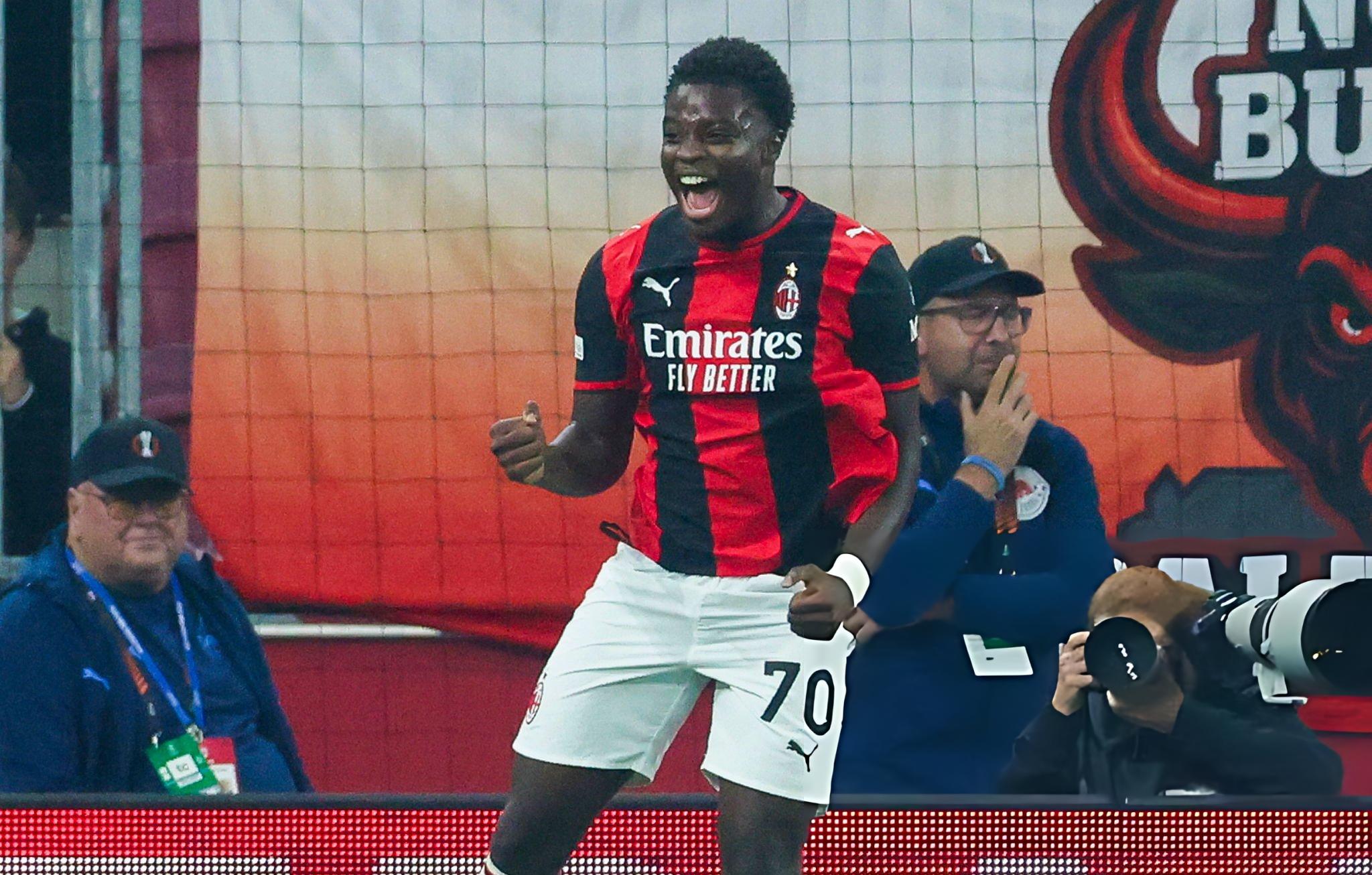
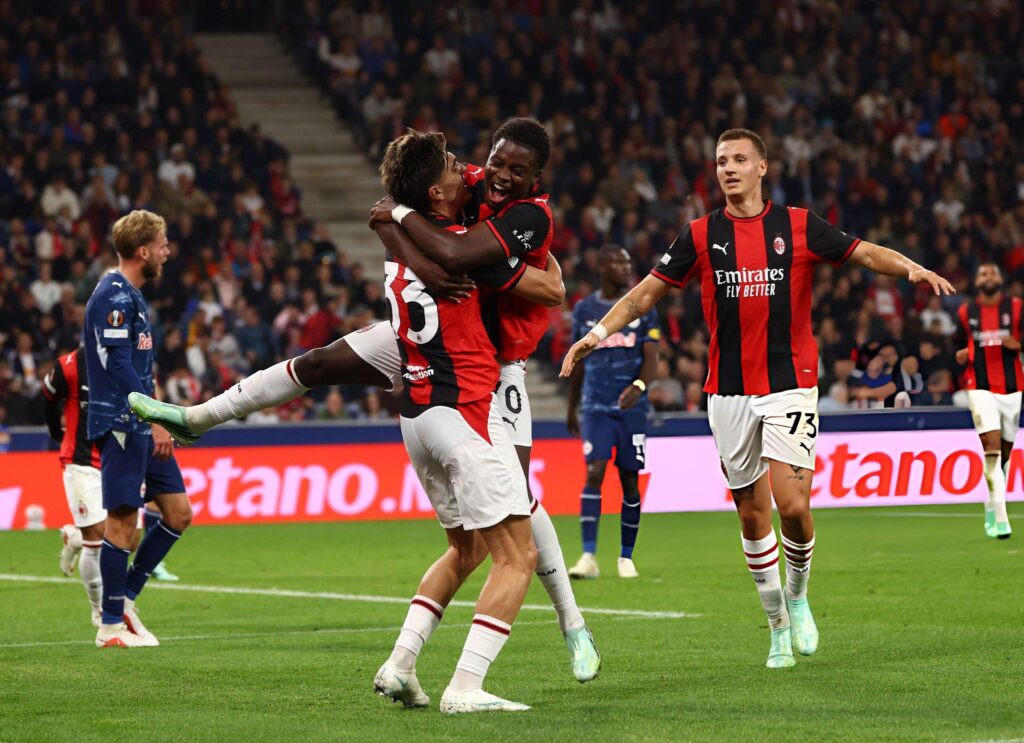
Scoring three goals in a European match changes how people talk about a young footballer overnight. When Alphadjo Cisse, then 19, struck a first-half pair and added a third shortly after the break in AC Milan’s 4-0 win away to RB Salzburg on 15 October, he gave the club’s supporters an unforgettable evening.
A performance like that always invites extreme reactions. Some observers wanted to crown him as Milan’s frontline star right away, while more cautious voices warned that one big night in Austria proved very little.
The events of the past month have shown that the sensible path lies between those two extremes. Since turning 20 on 22 October, Cisse has taken his 2026/27 tally to eight goals in 13 appearances across Serie A and the Europa League, making him Milan’s leading scorer this season. That run has brought his first senior Italy cap under Roberto Mancini on 15 November and prompted Milan to turn down a verbal transfer approach from Brighton & Hove Albion.
Cisse has not suddenly solved all of Milan’s collective problems or become a finished product. What the 20-year-old midfielder has done is give manager Ruben Amorim a clear reason to trust his penalty-box instincts while the club works out how to protect both his development and his contract status.
What the Salzburg hat-trick and Serie A goals actually show
Milan travelled to Austria in mid-October needing a response in the Europa League league phase after losing 2-0 at home to Benfica in their opening match. By the 50th minute, Cisse had settled the contest on his own, before Gonçalo Ramos added a fourth goal in the 72nd minute and Filippo Terracciano was sent off late in the game.
The variety of Cisse’s three finishes stood out in AC Milan’s official match report. His opener in the 15th minute came from an Omari Hutchinson cross, which Cisse met with a well-timed header. In the 32nd minute, after Adrien Rabiot opened up the Salzburg defence and Davide Bartesaghi supplied the final pass, the teenager finished cleanly with his left foot. Shortly after half-time, Rabiot delivered another cross into the box, and Cisse completed his hat-trick with his right foot.
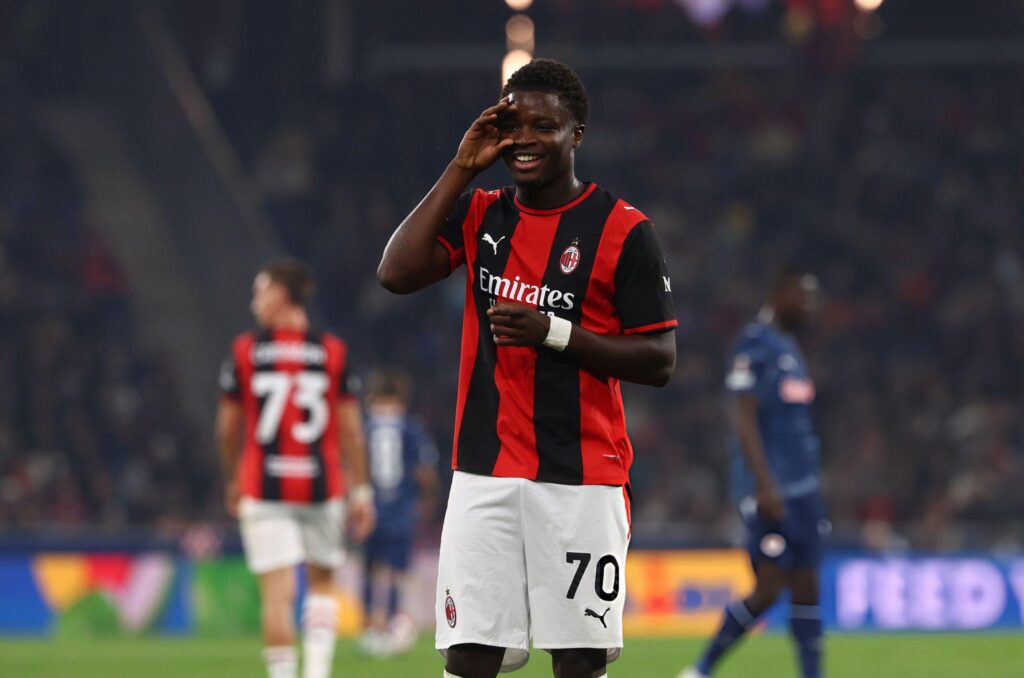
Scoring with his head, his left foot and his right foot in under an hour showed calm technique inside the penalty area. Even so, the movement before each shot mattered more than the finishes themselves.
Most young midfielders stay in safe zones outside the penalty box when they step up to senior European football. They ask for the ball to feet because they want to avoid mistakes. Cisse did the opposite in Salzburg, adjusting his stride every time Milan worked the ball wide and attacking the spaces between defenders.
His Serie A output confirms that those runs are a repeatable habit rather than a one-off burst. Before facing Salzburg, Cisse had scored on his Serie A debut against Torino on 23 August and found the net against Juventus in September. He then struck twice in the first half of a 4-2 home defeat to Bologna on 28 October, finishing in the 14th minute after a move involving Hutchinson and scoring again in the 27th minute from a Fikayo Tomori delivery. On 8 November, starting as an attacking midfielder away to Genoa, he opened the scoring with his right foot in the 13th minute of a 2-1 victory before Christian Pulisic doubled the lead six minutes later.
Five goals in nine Serie A appearances, spanning just over 400 minutes of league football, equals roughly one goal every 81 minutes. Combined with his three goals in four Europa League starts, he has given Milan a distinct tactical weapon from midfield.
When a striker like Ramos occupies the opposition’s centre-backs, those defenders have to keep their eyes on the front line. If Cisse times his forward sprint from midfield just as a teammate prepares to cross, an opposing midfielder has to track him all the way to the six-yard box. Even when the pass does not go to him, his forward runs force defenders to drop deeper toward their own goal line, opening room around the edge of the penalty area for teammates like Rabiot, Pulisic or Hutchinson.
Cisse has told Sky Sport Italia that he feels comfortable operating as a trequartista in the spaces behind the striker, and Mancini even tested him as a centre-forward in a 4-3-3 during Italy training at Coverciano in November. Even so, Milan should not confuse a high-scoring midfielder with a permanent number nine. Playing with his back to goal against two physical Serie A centre-backs is completely different from arriving unmarked from midfield at full speed.
Also Read: Nagaland United SC in the IFL: Debut win, squad, owners and stadium plans
From Treviso’s San Liberale district to San Siro and the Azzurri
Cisse’s composure in senior football makes more sense when you trace his upbringing and the route he took to San Siro. Born in Treviso on 22 October 2006 to parents from Guinea, he grew up in the working-class neighbourhood of San Liberale. Note that while his surname often appears with an accent in club URLs, Cisse clarified to MilanNews in August that his name is written without an accent and pronounced Sisse.
His father, Saloussy Cisse, works in a factory, and his mother, Habibatou, works as a hotel maid. Speaking to Goal.com Italia and AllFootballApp Italia, Cisse explained how his parents’ daily sacrifices shaped his career. His father used to finish his factory shift at 5:00 or 5:30 in the afternoon and rush home exhausted to take him to training or call him downstairs to play football. On other days, his mother took him by bus and walked the final stretch to the pitch on foot.
“My mother is a very strict mother, but she helps me keep my feet on the ground,” Cisse said, adding that his parents never let him feel inferior to anyone else. After scoring his first goal for Milan against Torino, he shared his main personal ambition:
I couldn’t even dream that one day I would score a goal for Milan. My next dream is to buy my parents a new house. I hope I will soon have enough money to make them stop working.
In an interview with Il Nordest after that Torino match, Habibatou admitted that she and her husband were too nervous to watch the second half live on television, checking her phone before celebrating on a family video call with Alphadjo and his brothers. She recalled that he grew up idolising Paul Pogba while supporting AC Milan as a boy.
On the pitch, Cisse started at local Treviso club Polisportiva Indomita 21 before moving to Giorgione Calcio 2000 in Castelfranco Veneto in 2018. Former youth coach Michele Coco told Mozzart Sport that when Cisse was 12, he challenged the youngster to copy Marco van Basten’s famous 1992 scissor-kick goal against IFK Göteborg, and Cisse pulled it off three times in a row.
He joined the Hellas Verona academy in 2020, scoring 20 goals in 56 games for the under-19 side, making his senior debut in the Coppa Italia against Ascoli in August 2023 and playing his first Serie A minutes against Inter in May 2024. The toughest step in his football education came during a Serie B loan spell at Catanzaro in the 2025/26 season, where he had to find space against experienced second-tier defenders. He scored six goals in 22 appearances during the first half of that campaign before an injury interrupted his run.
Cisse later confirmed that he was close to joining PSV Eindhoven in early 2026 before Milan stepped in. The Rossoneri deposited his contract on 2 February 2026 in a permanent deal reported across Italian outlets at between €8 million and €8.4 million, plus up to €1.5 million in bonuses, while leaving him on loan at Catanzaro until June.
Although eligible for Guinea through his parents, Cisse has represented Italy from under-16 through under-21 level, scoring for the under-21 side against Armenia on 1 October. On 9 November, Mancini called him up to the senior Italy squad for the first time alongside former Catanzaro teammate Mattia Liberali. “I like pressure, I have broad shoulders,” Cisse told reporters at Coverciano on 10 November.
Five days later, on 15 November, he made his senior Italy debut away to Belgium in the Nations League, coming off the bench in the 62nd minute of a 4-1 defeat, completing 12 of 13 passes, seeing a goal disallowed and winning a 91st-minute penalty.
Also Read: Could an EFL League One luxury tax curb rising third-tier wages?
Balancing opportunity and patience under Ruben Amorim
After the Salzburg victory in October, Amorim praised Cisse’s explosiveness and work ethic while pointing out that the youngster still had plenty of areas to improve. The seven club fixtures since that night in Austria show how the Milan coach has tried to balance opportunity with protection, and why Cisse still needs time to develop his all-round game.
Amorim left Cisse on the bench during a demanding 3-2 win over Atalanta on 18 October, started him on his 20th birthday in a 3-0 Europa League loss at Bournemouth on 22 October, and brought him on as a substitute in a 2-0 win at Udinese on 25 October. After Cisse scored twice in the first half against Bologna on 28 October, Milan collapsed after the break to lose 4-2, a reminder that individual goals cannot hide wider defensive flaws.
That pattern of careful rotation continued into November. Cisse played the final nine minutes off the bench in Milan’s 3-1 derby victory over Inter on 31 October, registering a shot on target to help see out the win. Five days later, he started on the left of midfield at San Siro against Ferencváros in the Europa League, but picked up a yellow card in the 32nd minute and was replaced by Pulisic at half-time as Milan slumped to a 2-0 defeat.
Rather than dropping him from the picture, Amorim restored Cisse to his favoured attacking midfield role at Genoa on 8 November, and the 20-year-old rewarded that faith with the opening goal and 15 completed passes out of 16 across 61 minutes.
As examined in our analysis of Endrick and Real Madrid, young attackers only turn raw promise into consistent output when a coach trusts them with real minutes in meaningful fixtures. Difficult nights like the defeats to Bournemouth and Ferencváros are a normal part of learning top-flight football at 20.
There will be tight matches after the international break, starting against Frosinone on 22 November, where Milan need midfielders who can slow the tempo down, keep possession under heavy pressing and protect the back line for 90 minutes.
Also Read: Newcastle scout Valencia winger David Otorbi after hamstring injury
Rejected Brighton approach, Arsenal interest and contract talks
Eight goals before mid-November and a senior Italy cap have inevitably accelerated transfer activity and contract speculation around Milan’s number 70. According to Fabrizio Romano and Football Italia on 12 November, Brighton & Hove Albion made a verbal approach to AC Milan in November to gauge the possibility of signing Cisse. No proposed transfer fee was disclosed, and Milan rejected the approach outright, telling suitors that the midfielder is central to their long-term plans.
Tuttomercatoweb and Football Italia report that Arsenal are also monitoring Cisse closely, while transfer reports have linked Aston Villa and Newcastle United with scouting his recent matches. While algorithmic databases such as Transfermarkt currently list his market value at €20 million, Italian media reports suggest Premier League interest has pushed Milan’s internal valuation toward €50 million to €60 million.
To strengthen their position, Milan have been working to update Cisse’s contract, which already runs until 30 June 2030. Goal.com and PianetaMilan report that he currently earns close to €800,000 a season, and club directors want to offer him a significant pay rise alongside an extension to 2031, with an option for 2032. Even so, Tuttomercatoweb cautioned in mid-November that a renewal is not yet finalised, and no official agreement had been signed as of 16 November.
Across the football pyramid, clubs use contracts in different ways to manage risk, whether that involves tying down an Italy international into the next decade or arranging the kind of brief deal. For Milan, rejecting Brighton and preparing a pay rise makes clear business sense after paying Verona around €8 million in February.
Still, a higher salary and a €60 million price tag only protect the club’s balance sheet. They do nothing to improve a young player’s positional discipline in midfield or his decision-making against deep Serie A defences.
Cisse has earned his place in Milan’s rotation and Italy’s senior squad through hard running and sharp finishing. How far he goes from here will be decided on the training pitches at Milanello rather than at the negotiating table.