
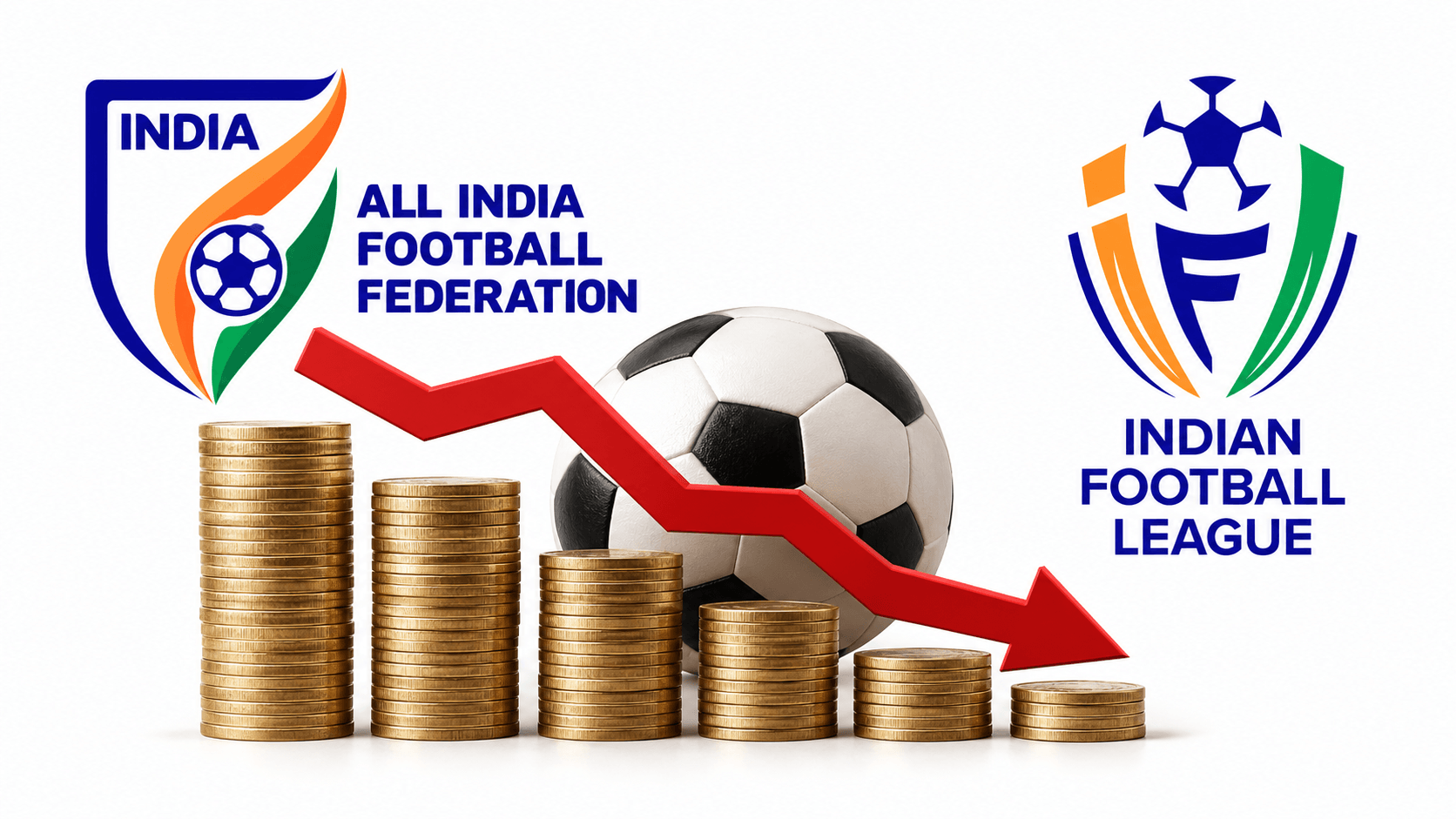
Winning promotion on the pitch is supposed to be the hardest part of professional football. For clubs competing in India’s national pyramid, however, earning a place through sporting merit is increasingly followed by a second, harsher test in the boardroom. As the second-tier Indian Football League, or IFL, prepares for the 2026-27 season, a prolonged financial dispute between member clubs and the All India Football Federation, or AIFF, has exposed how easily heavy administrative costs can threaten a team’s right to compete.
This standoff is about much more than an accounting disagreement among the eleven participating clubs. Formerly known as the I-League before its rebrand for the 2025-26 campaign, the second division serves as the main proving ground for domestic Indian players and the lifeblood of regional football communities from Mizoram to Goa.
The danger of pricing teams out of national competition became clear in August 2026, when 2025-26 IFL champion Diamond Harbour FC was barred from taking its promoted spot in the top-flight Indian Super League, or ISL, after missing the deadline for its second ₹55 lakh entry fee instalment. When league fees become impossible for rising clubs to pay, financial strength replaces football performance as the true gatekeeper of the sport.
How the financial dispute began
The crisis in the second tier started in July 2026, when the AIFF proposed a major shift in how the league is owned and funded. Historically, the national federation managed the second division directly. It paid for central league operations, such as television production, referee appointments, and match logistics, while clubs paid a modest entry fee that stood at ₹23.60 lakh including taxes for the shortened 2025-26 season.
At a Governing Council meeting on July 27, 2026, federation officials presented a new club-led commercial framework. The AIFF estimated the total central operating budget for the 2026-27 IFL season at ₹13.21 crore for basic match operations, rising to ₹15.16 crore with full marketing and promotional events. Instead of funding that central budget itself, the federation proposed dividing the league’s operating expenses across the participating clubs.
Depending on the final budget and how those central costs were split, each club faced a projected contribution between approximately ₹1.20 crore and ₹1.37 crore for the season. Although different figures appeared in subsequent club letters and media reports, they all referred to a club’s share of this central operating budget rather than separate entry fees. Under the initial schedule set in July, clubs were ordered to pay a mandatory ₹20 lakh first instalment by August 15, with the remaining balance due in later stages.
In exchange, the AIFF offered the clubs a 90:10 commercial ownership arrangement. Owning a league’s commercial rights gives clubs the legal power to sell broadcast deals and tournament sponsorships and keep the resulting income. Under this proposal, the clubs would collectively own 90 percent of the league’s commercial entity, while the AIFF would collect a 10 percent royalty on net commercial revenues.
Also Read: How TRAU and NEROCA fell to the fourth tier of Indian Football
On paper, this looked like a step toward club independence. In practice, owning commercial rights also means paying the bills when sponsors cannot be found. While the AIFF kept complete regulatory authority over match rules, refereeing, and player discipline, the proposed structure transferred 100 percent of the central operating costs and financial risk onto the clubs before any commercial income was secured.
The scale of that demand looked even more troubling alongside the top flight. Earlier in July 2026, the AIFF set the annual participation fee for ISL clubs at ₹1.10 crore, split into two equal instalments of ₹55 lakh. The two leagues operate under different commercial structures and carry different obligations, as top-tier clubs manage their own central commercial entity alongside major national broadcast and sponsorship assets.
Even so, the original IFL proposal created an upside-down system in which second-tier clubs with limited regional income were asked to contribute more toward central league costs than elite top-division sides.
Why Chanmari FC and Dempo SC objected
Pushback from the clubs was swift, led by two institutions from very different backgrounds that highlighted distinct flaws in the federation’s plan.
In Aizawl, community-backed Chanmari FC had earned its place in the national second tier through promotion from I-League 2 before finishing fifth in the 2025-26 standings. In early August, club president Vanlalruatfamkima wrote to the federation as Chanmari raised concerns over the new IFL model, objecting to an expected contribution of ₹1.23 crore, the initial ₹20 lakh instalment, and the 90:10 ownership structure.
Chanmari warned that demanding over a crore in league costs placed an unfair hurdle in front of financially weaker community teams that operate without wealthy corporate owners. Vanlalruatfamkima also argued that handing league finances over to the clubs would allow rich corporate sides to shape commercial rules in their own favor, threatening equal access to national competition.
Five-time national champion Dempo SC of Goa challenged the proposal from the perspective of responsible budgeting and long-term club stability. In August, club president Shrinivas Dempo warned that Dempo might reconsider its IFL future over the fee hike, noting that the club’s required central contribution would jump from roughly ₹30 lakh in the 2025-26 season to about ₹1.30 crore.
Shrinivas Dempo cautioned that a cost increase of more than 300 percent in a single year could force the club to divert money away from its youth academies, training centers, and grassroots coaching programs just to cover senior league expenses.
That warning exposed a sharp contradiction in federation policy, as the AIFF Governing Council had just ordered all second-tier clubs to meet strict two-star and three-star youth academy accreditation standards between 2027 and 2030.
Rather than simply rejecting reform, Dempo called for a realistic commercial roadmap in which the AIFF would secure central sponsors before billing clubs, cap the total league budget at ₹10 crore, and keep the previous season’s cost-sharing ratio where clubs paid 60 percent of central costs and the federation covered 40 percent.
Also Read: NorthEast United’s fast start: Can they challenge for the ISL title?
The gap between viewership and revenue
Throughout the dispute, federation leaders defended their commercial ambitions by pointing to growing audience numbers. When the AIFF officially announced that the Indian Football League 2026-27 season would begin on October 30 following its September 8 Governing Council meeting, it cited a fourfold increase in television viewership during the 2025-26 season, reaching a cumulative audience of 17.56 million viewers.
The announcement also noted that federation officials and club representatives met with Prasar Bharati Chief Executive Gaurav Dwivedi on September 7 to discuss broadcasting arrangements for the upcoming campaign.
Expanding the league’s television footprint on Doordarshan’s DD Sports channel and the Waves mobile app is a positive step for public visibility. Moving matches away from paid online streams and placing them on a free-to-air public broadcaster available in millions of households through DD Free Dish naturally brought more eyes to the second division.
However, audience reach is not the same thing as cash revenue. The partnership with Prasar Bharati operates as a free-to-air public-service broadcast arrangement rather than a commercial media deal that pays multi-crore rights fees to the league or its clubs.
Meanwhile, every club still has to fund its own internal operations, including player and coaching wages, home stadium rentals, and flights and hotels for ten away trips stretching across India from Srinagar and Aizawl to Kozhikode and Margao. Asking clubs to underwrite the league’s central budget on the strength of free-to-air viewership numbers confuses publicity with income.
Was the reported fee reduction enough?
Faced with united pushback from its clubs, the federation eventually stepped back from its initial demands to prevent a boycott. In late September, My Khel reported that the AIFF planned to slash the upfront IFL participation fee down to ₹20 lakh, with federation officials stating that central corporate sponsorships would be brought in to cover the rest of the league’s operating costs.
This revised figure differs from the ₹20 lakh payment ordered in July, which was merely the first instalment of a total bill exceeding ₹1.20 crore per club. By contrast, the ₹20 lakh figure reported in September was presented as a reduced upfront participation fee that allowed clubs like Chanmari FC and Dempo SC to confirm their entries and prepare for the season opener on October 30.
Even with all eleven clubs set to kick off the campaign, the financial dispute cannot be described as completely resolved. The reported reduction emerged through media reporting and verbal assurances rather than a published, legally binding federation circular, and no publicly available, binding document has confirmed that the remaining central deficit obligations have been permanently cancelled.
If the promised central sponsorships fail to cover the full operating budget, it remains unclear whether the clubs could still be billed for the shortfall later in the season.
Also Read: First from the state: Nagaland United SC gears up for debut in IFL
The case for shared responsibility
A fair assessment of Indian football’s finances must recognize that the AIFF cannot run national competitions at an unlimited loss forever. As central commercial revenues have tightened and operational bills have grown, the federation has valid reasons to push domestic leagues toward financial independence.
Giving clubs a direct stake in commercial ownership can bring real benefits when structured properly. When clubs share in league revenues, they have a stronger incentive to professionalize their front offices, pursue regional sponsors, grow their matchday audiences, and build durable local brands instead of waiting for annual subsidies from New Delhi.
At the same time, clubs have a responsibility to manage their own spending with discipline, pay their players on time, and prove that they have the financial stability to complete a full national fixture list.
Yet financial discipline has to apply to the league’s central budget as well. The flaw in the AIFF’s July proposal was not the goal of commercial growth, but the decision to transfer heavy operating risks onto second-tier clubs before the league’s income was established.
When central costs outpace commercial reality, historic and community clubs are pushed to the brink, a pressure already visible before this season when former national champion Aizawl FC transferred its league rights to Nagaland United due to financial strain.
Indian football needs a second tier that is commercially ambitious, but it cannot build that future by pricing out the clubs that keep the regional game alive. True commercial ownership requires a transparent operating budget, confirmed central sponsorship deals before bills are issued, and clear, written rules specifying who covers the loss if revenues fall short.
For the second division to thrive, the AIFF and its member clubs must share financial risk fairly and protect the principle that a club’s place in Indian football is earned on the pitch.