
Professional Footballers Australia, the players’ union known as the PFA, has challenged Football Australia‘s disciplinary process after Perth Glory captain Tom Lawrence and Auckland FC striker Sam Cosgrove were hit with suspensions and fines over separate public remarks.
On Wednesday, the union confirmed that it is backing Perth Glory’s appeal against the one-match suspension and A$1,000 financial sanction handed to Lawrence. The PFA also offered to support Auckland FC if the club appealed Cosgrove’s penalty. However, Auckland and the striker chose to accept his punishment after weighing the potential consequences of an unsuccessful appeal.
PFA chief executive Beau Busch called the penalties disproportionate and said they marked a major shift from how similar incidents have historically been handled in professional football. Alongside the two individual cases, the union renewed its call for Football Australia’s Code of Conduct to be negotiated collectively with players rather than imposed by the governing body alone.
Although both punishments were issued by the same governing body under the same disciplinary code, the conduct in each case was very different. Lawrence questioned the refereeing after a close defeat, while Cosgrove was punished following an angry confrontation with a journalist.
Keeping those two situations distinct is essential when judging the fairness of the penalties and the wider debate over what professional footballers can say in public.
Tom Lawrence’s post-match comments and Perth Glory’s appeal
Lawrence’s case stemmed from Perth Glory’s 2-1 loss to Macarthur FC on 17 October. Lawrence had put Perth ahead in the 59th minute with a goal from outside the penalty area, and his side held that lead for much of the second half. The game turned late on when Macarthur were awarded a penalty. Perth goalkeeper Matt Sutton saved Ryan Fraser’s initial spot-kick, but the referee ordered a retake after a Perth player was penalised for encroachment.
Fraser converted the retake in the 86th minute, and Jonathan Aspropotamitis headed in the winning goal three minutes later to leave Perth empty-handed. The full match timeline is covered in Macarthur FC’s report of the 2-1 win.

Speaking to broadcaster Paramount+ after the final whistle, Lawrence openly questioned the penalty call and his attempt to get an explanation from the referee. He described the call as a “horrendous decision” and said it made a mockery of the league.
Football Australia responded by giving Lawrence a one-match suspension and a A$1,000 financial sanction for an alleged breach of its National Code of Conduct and Ethics. The PFA is now supporting Perth Glory’s appeal against the ruling, and no outcome to that appeal had been reported by the time the union issued its statement on 28 October.
In football, players, coaches, and supporters regularly disagree with match officials, and frustration after a tight or controversial defeat is a familiar part of the sport. The central question in Lawrence’s case is not whether he had a right to disagree with the referee, but where a governing body should draw the line between strong post-match criticism and behaviour that warrants a disciplinary ban.
The public material available for this report does not include the full case-specific ruling against Lawrence or its detailed written reasoning. Without that information, it is hard to verify the exact rule provision applied, the specific factors weighed by the panel, or how the fine amount was calculated.
Because of those gaps, the PFA’s claim that the penalty breaks with past precedent should be viewed as the union’s argument rather than an independently established fact.
Also Read: The Australian Championship is growing, but does it pay off for clubs?
Sam Cosgrove’s reserve-team ban and press conference clash
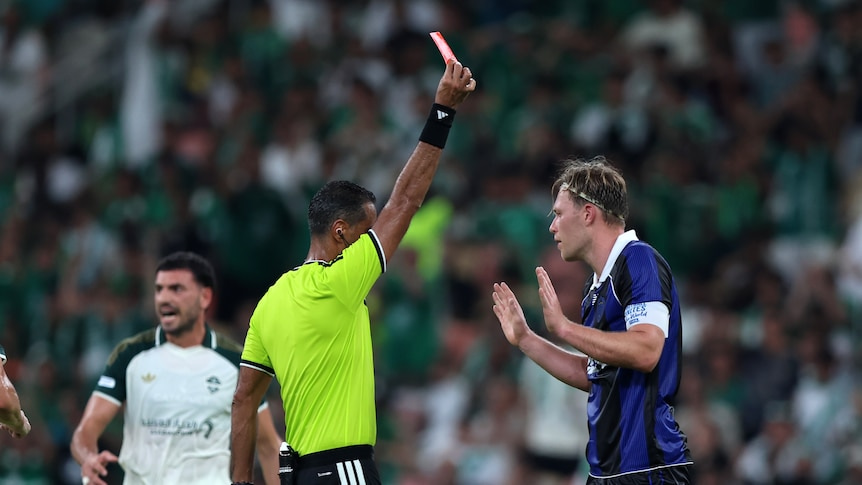
Cosgrove’s case began with an earlier suspension from a different tournament. The Auckland FC striker was sent off during his club’s 1-0 defeat to Saudi side Al-Ahli in the FIFA Intercontinental Cup in August, resulting in a two-match ban. Auckland then arranged for him to serve that suspension while playing for its reserves side in New Zealand’s domestic National League.
Under New Zealand Football’s participation agreement and competition regulations, Auckland is allowed to field A-League professionals in its reserve team within set limits. Cosgrove sat out reserve-team fixtures against Wellington Olympic and Miramar Rangers before Auckland’s A-League Men campaign began. That arrangement drew media scrutiny because it cleared the striker to play in Auckland’s opening two A-League Men matches.
At a press conference on 15 October, Stuff journalist Andrew Voerman asked Cosgrove about how the suspension had been served and whether he felt uncomfortable with the move being described as a loophole. Cosgrove defended the club’s decision to use the rules available to it, but the exchange grew heated and the press conference ended abruptly.
During the argument, Cosgrove swore at the reporter and warned that he would be barred from returning, saying, “We’ll just f*** you off. You won’t get back here again.” Unlike post-match complaints about a referee, those remarks went beyond a football decision and raised a separate issue regarding how a professional player treats a working journalist.
Football Australia handed Cosgrove a two-match suspension, with one match suspended for the remainder of the 2026/27 A-League Men season, alongside a A$2,000 fine. The governing body stated that he had failed to uphold the standards of integrity, dignity, and professionalism expected of a professional footballer under its National Code of Conduct and Ethics.
The immediate one-match ban means Cosgrove is due to miss Auckland’s away fixture against Brisbane Roar on 30 October. He will be eligible to return against Wellington Phoenix on 7 November, provided no other restriction applies. The suspended second match will be triggered if he commits another breach involving the same or similar conduct during the rest of the 2026/27 season.
Auckland FC confirmed that both the club and Cosgrove accept the penalty and will not appeal. The PFA noted that it had offered to back an appeal, explaining that the club and player were concerned about the possible consequences if a challenge failed. Accepting the ruling does not necessarily mean they agree with the sanction, only that they have chosen not to contest it.
Further background on the reserve-league arrangement and the media confrontation can be found in the ABC’s report on the original press-conference exchange. The A-Leagues’ report on the sanction confirms the details of the ban and Auckland’s decision not to appeal.
Proportionality, media duties, and the disciplinary framework
In its statement published on 28 October, the PFA argued that both punishments point to wider problems with Football Australia’s disciplinary approach. Busch contended that the sanctions were disproportionate and departed significantly from how comparable cases had been handled in the past.
The union’s view is that professional footballers are required to speak with the media and engage with fans, including during difficult moments on the pitch, and should be able to do so without facing unreasonable disciplinary penalties. It wants Football Australia to use its regulatory powers fairly and reasonably.
Finding the right balance involves competing responsibilities. Players act as public representatives for their clubs and leagues, which gives governing bodies a valid reason to set professional conduct standards.
Strong criticism of match officials does not automatically amount to misconduct, but being a professional athlete does not put every public remark beyond disciplinary review either. At the same time, journalists must be able to ask tough questions at press conferences without facing profanity or threats to their future access.
For any disciplinary system to work well, the rules need to be clear, the process must be fair, and the punishment should fit the offence. Consistency across cases is also vital. If similar incidents result in very different penalties, a governing body should be able to explain why.
Also Read: Why Top Players Are Leaving the A-League Women Ahead of the New Season
Still, proving that the Lawrence and Cosgrove sanctions break with precedent would require a detailed comparison with past cases, including the exact conduct and written reasoning in each decision. While the PFA has made that claim, the publicly available material reviewed for this article does not independently prove it.
Just as importantly, the two incidents should not be treated as identical examples of players being punished for speaking their minds. Lawrence’s comments focused on a refereeing decision after a match, whereas Cosgrove’s penalty followed an outburst that included swearing and a threat to block a reporter’s access. Those differences matter when judging whether each punishment was proportional.
Collective bargaining and who writes the rules
The PFA’s challenge goes beyond the two individual bans and raises a broader question about football governance. The union argues that because Football Australia’s Code of Conduct has a material effect on professional players’ employment, the rules should be negotiated through collective bargaining rather than applied unilaterally.
That demand highlights an ongoing tension over who sets the rules in professional sport and how those standards are enforced when disputes arise. As the governing body, Football Australia is responsible for protecting the game and enforcing conduct standards.
Players, meanwhile, are directly affected by those rules and the financial or sporting penalties attached to breaches, which is why the PFA says they should have a formal voice in negotiating them.
Nothing in the union’s statement establishes that Football Australia has agreed to this demand or that negotiations over the code have started because of these two cases. Nor does the PFA’s criticism establish that either punishment was unlawful. Answering those questions would require additional evidence, including the full disciplinary rulings and any official response from Football Australia.
Also Read: Birkirkara FC handed three-window FIFA transfer ban over debt
What to watch next
The immediate development to watch is the outcome of Perth Glory’s appeal against Lawrence’s one-match suspension and A$1,000 fine. While the PFA is publicly backing the club, no decision overturning or reducing the sanction had been announced as of 28 October.
Cosgrove’s case is moving on a different path. Because Auckland FC and the striker accepted his punishment, he is set to miss the 30 October match against Brisbane Roar. Barring any unexpected turn, further debate around his case will focus on Football Australia’s wider rulebook and the PFA’s governance concerns rather than an active club appeal.
The key questions for the league are whether Perth Glory’s appeal changes Lawrence’s penalty, how Football Australia explains its handling of both cases, and whether the governing body and the players’ union can reach common ground on how the Code of Conduct is written and enforced.